




As school leaders, we’re constantly moving forward, planning initiatives, solving problems, supporting teachers, and guiding students. But in the midst of all that momentum, are we pausing long enough to learn from where we’ve been?
That’s where Learning Loops come in.
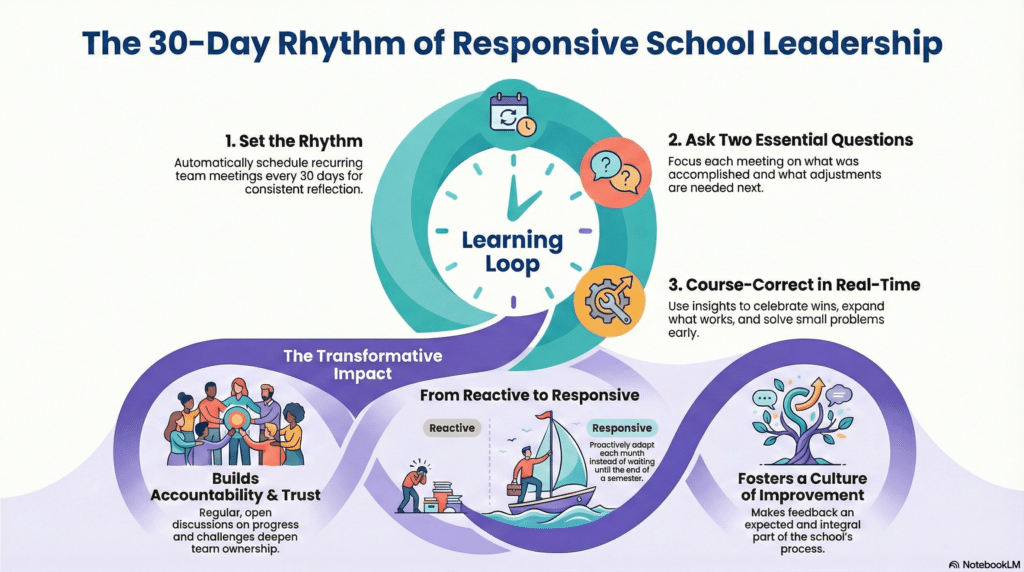
Think of Learning Loops as your leadership rhythm—a 30-day cycle of intentional reflection and recalibration that keeps your school moving in the right direction. It’s a structured approach to continuous improvement that doesn’t wait for annual reviews or end-of-year evaluations. Instead, it embeds learning and adjustment into the DNA of how you lead.
The beauty of Learning Loops is in their simplicity and consistency. Every 30 days, meetings are automatically scheduled no need to remember or worry about when to check in. You and your team gather with a clear purpose: to reflect, learn, and adjust.
At each session, you focus on two essential questions:
That’s it. But don’t let the simplicity fool you: the impact is profound.
Want to hear exactly how to run a Learning Loop meeting? Listen below as I walk you through the step-by-step process.
Who’s in the room: Your admin team, department heads, and grade level leaders—the people who have their finger on the pulse of what’s happening across your campus.
How long it takes: About an hour. That’s it. You’re not asking for half a day or marathon sessions. Just one focused hour every 30 days.
Who leads: Admin facilitates the meeting, but everyone contributes. This isn’t a top-down report-out; it’s a collaborative conversation.
The agenda: Keep it simple. The entire meeting revolves around the two big questions:
That’s your agenda. Don’t overcomplicate it.
Here’s where it gets specific to your campus. The data you review should be based on what your campus is currently focusing on. This might include:
The key is that you’re not looking at ALL the data ALL the time. You’re focusing on the metrics that matter most to your current priorities. If this semester you’re laser-focused on chronic absenteeism, that’s what you’re tracking. If next semester it’s math proficiency, the data shifts.
You might be asking, “How is this different from a data day?” Data days happen less frequently and focus primarily on “how” students are performing. The whole staff comes together to diagnose where students are struggling and what interventions are needed. Whereas, Learning Loops happen every 30 days and focus on “what” supports “adults” are providing, and what’s working. Learning Loops also involve your admin/leadership team, and we are all about action and accountability.
The bottom line is you’re not just analyzing what’s happening with students; you’re evaluating what “you’re” doing as leaders and committing to change course quickly when needed. Think of it this way: Data Days zoom in on students. Learning Loops zoom in on your leadership moves. Both are essential, but they serve different purposes.
Before the meeting, each leader brings the data that shows gains or declines in the area being monitored. This isn’t about creating elaborate presentations. It’s about coming prepared with the numbers, trends, or evidence that tell the story of the last 30 days.
For example:
Come with your data. Come ready to discuss what it means.
Once everyone’s in the room, the conversation flows naturally around those two questions. You celebrate what’s working. You name what’s not. You problem-solve together.
“Our Tier 2 reading intervention is showing real growth—students are averaging 1.2 years of growth in fluency. Let’s expand to the next cohort.”
“Morning tardies have increased by 15%. What’s happening? Do we need to revisit our procedures? Add more staff supervision?”
“Teachers are reporting they don’t have enough time to analyze data during PLC. Can we adjust the PLC structure to give them 15 more minutes?”
The beauty is in the honesty and the immediacy. You’re not waiting months to discover something isn’t working. You’re catching it now.
However you capture it—Google Doc, shared notes, a simple template—write down what you accomplished and what adjustments you’re making. This documentation becomes your roadmap for the next 30 days and your accountability measure when you reconvene.
Without documentation, the loop breaks. With it, you have a trail of continuous improvement that tells the story of your school’s growth over time.
One of the most powerful outcomes of Learning Loops is how they build shared accountability and heighten trust between team members. When everyone knows they’ll reconvene in 30 days to discuss progress and challenges openly, something shifts. Ownership deepens. Collaboration strengthens. People stop pointing fingers and start problem-solving together.
There’s transparency in knowing that what you commit to today will be revisited next month—not as a gotcha moment, but as an opportunity to learn and grow together. This regular rhythm creates psychological safety where team members feel comfortable sharing what’s working and what’s not.
Instead of waiting until the end of the semester or school year to realize something isn’t working, you’re course-correcting in real time. You’re celebrating wins while they’re fresh. You’re catching problems while they’re still small and manageable.
Here’s what this might look like in practice:
Each of these scenarios benefits from early detection and quick response, rather than letting issues compound over months.
Every 30 days, take a step back and ask yourself: Are our efforts working?
This personal reflection is just as important as the team conversation. It keeps you grounded in the purpose behind all the activity. It helps you distinguish between busy work and meaningful progress. It ensures that you’re not just doing things, but learning from them.
Learning Loops transform leadership from reactive to responsive. They create a culture where feedback isn’t feared—it’s expected. Where change isn’t disruptive—it’s part of the process. Where improvement isn’t a once-a-year initiative—it’s a monthly practice.
The schools that thrive aren’t the ones with perfect plans. They’re the ones that learn and adapt quickly. They’re the ones that create space for reflection, embrace adjustment, and maintain momentum through continuous improvement.
That’s what Learning Loops give you: the discipline to pause, the courage to adjust, and the momentum to keep improving.
If you’re ready to implement Learning Loops in your school, start simple:
The first loop might feel awkward or uncertain. That’s normal. By the third or fourth loop, you’ll find your rhythm. And six months in, you won’t be able to imagine leading without this practice.
What’s your school working on this 30-day cycle? What would change if you paused every month to learn and adjust together?

I’m Stephanie, and I’m the face behind Principal Principles. I’m a former principal turned educational consultant, presenter, and edupreneur. I’m obsessed with giving school leaders the tools they need to lead a successful school.

Hello friend! Welcome to Principal Principles. I’m Stephanie, and I’m the face behind Principal Principles. I’m a former principal turned educational consultant, presenter, and edupreneur. I’m obsessed with giving school leaders the tools they need to lead a successful school.
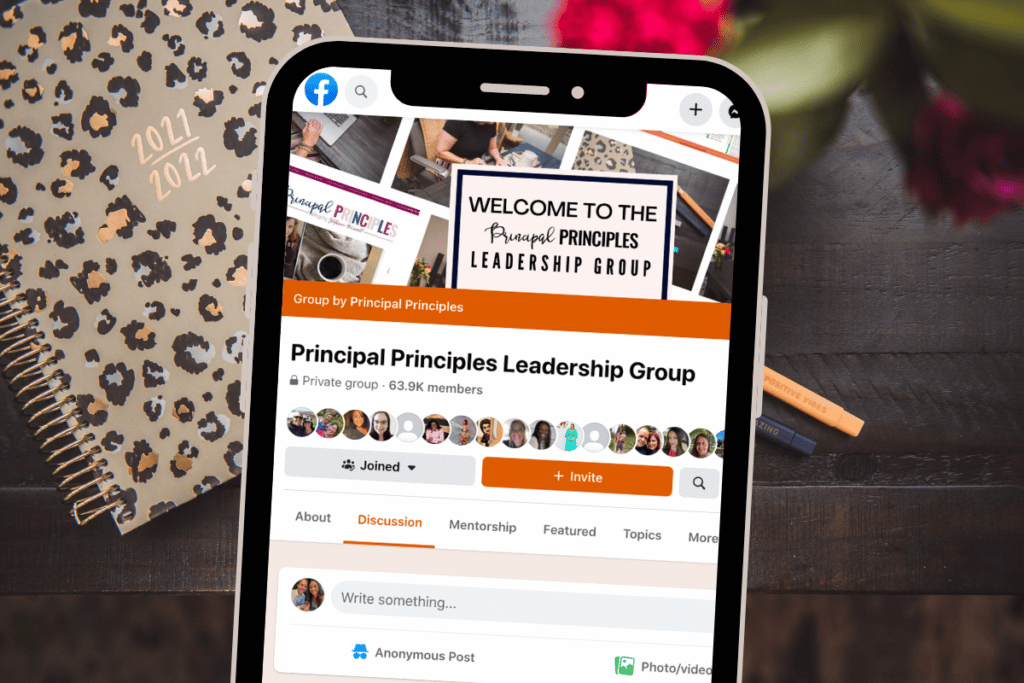
Join over 63,000 leaders in our Facebook group! Principal Principles Leadership is a professional learning network for future and current school leaders. We share ideas and resources every day!
A description of what the benefit is of joining your list. Updates, sale notifications, resources?